
How Solid-State Microwave Generators Improve Industrial Heating
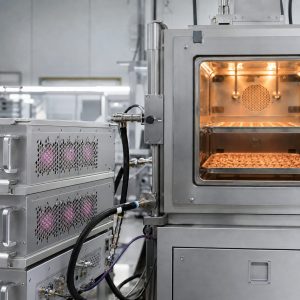
Industrial heating has always depended on one critical factor: delivering energy into the material in the most effective way possible.
For decades, many industrial microwave heating systems have relied on magnetron-based technology. Magnetrons are powerful and familiar, but they offer limited control, limited feedback and a lifetime that can become a challenge in demanding production environments.
Solid-state microwave generators are changing that.
By using transistor-based RF technology, solid-state microwave systems can deliver controlled, programmable and highly stable energy. For industrial heating applications, this means better process consistency, improved reliability and more intelligent energy delivery.
Why industrial heating needs better control
Industrial heating is not just about applying heat. It is about applying the right amount of energy, in the right place, at the right time.
In applications such as food processing, drying, pasteurization or material treatment, the load can change during the process. Moisture content, temperature, density and dielectric properties may all evolve as heating progresses.
A traditional magnetron-based system has limited ability to adapt to those changing conditions. This can lead to uneven heating, inefficient energy use or process variation.
Solid-state microwave generators help solve this by giving engineers more precise control over the RF energy source.
What are solid-state microwave generators?
Solid-state microwave generators use semiconductor technology to generate RF or microwave power. Unlike magnetrons, which are vacuum tube devices, solid-state systems are electronically controlled and can be adjusted with much greater precision.
In practical terms, this allows control over parameters such as:
- Power level
- Frequency
- Phase
- Pulse modulation
- Forward and reflected power monitoring
- Multi-channel operation
- Software-based process control
This makes the microwave generator part of the process control system, not just a power source.
More precise energy delivery
One of the strongest advantages of solid-state microwave generators is precision.
In industrial heating, precision matters because materials do not always absorb microwave energy in the same way throughout the process. As the material changes, the RF system must be able to respond.
Solid-state RF systems can adjust power output and frequency more accurately than traditional magnetrons. pinkRF RF power generators, for example, support control of frequency, level, phase and PWM modulation, helping engineers fine-tune the energy delivery for the application.
This level of control can support more stable and repeatable heating results.
Better process consistency
Consistency is one of the most important requirements in industrial production.
If a heating process behaves differently from one batch to the next, it can affect product quality, throughput and operational efficiency. Solid-state microwave generators help reduce this variability by delivering programmable and measurable RF power.
Instead of relying on a fixed or limited microwave output, engineers can design heating profiles that match the process requirements more closely.
This is especially relevant in applications such as industrial drying, food processing and pasteurization, where process repeatability directly affects quality.
Improved reliability and lifetime
In industrial environments, downtime is expensive.
Magnetrons degrade over time and may require replacement or maintenance. This can interrupt production and affect the stability of the heating process.
Solid-state microwave generators are designed for long-term stability and robustness. pinkRF highlights that solid-state RF solutions can increase RF source lifetime and reduce unscheduled downtime in industrial heating applications.
For production teams, this is not only a technical advantage. It directly supports better uptime, easier maintenance planning and a lower total cost of ownership.
Faster and more efficient heating processes
RF and microwave heating can provide volumetric heating, meaning energy can be delivered throughout the material rather than only from the surface inward.
This can help accelerate heating processes compared with conventional techniques. pinkRF identifies industrial applications such as food pasteurization and material drying as examples where RF ovens can enable faster processing and higher throughput.
When this volumetric heating capability is combined with solid-state control, the result is a more intelligent process: faster energy delivery with better control over how that energy is applied.
Better insight into reflected power
Industrial heating loads can be dynamic. As the material heats, its interaction with RF energy can change.
This is why reflected power matters. If energy is not efficiently absorbed by the load, part of it can be reflected back through the system. Monitoring this behavior is important for both process performance and system protection.
pinkRF power amplifiers include built-in couplers and detectors for forward and reflected RF power levels. This gives engineers better visibility into the RF system and helps support more controlled energy delivery.
Easier integration into advanced systems
Modern industrial heating systems often require software control, automation and integration with production equipment.
Solid-state microwave generators are well suited to this because they can be integrated with digital control systems. pinkRF RF generators include software support such as GUI control, API access, programming examples and LabVIEW driver availability.
For engineering teams, this makes it easier to develop application-specific heating systems with repeatable recipes, monitoring and automated operation.
Applications in industrial heating
Solid-state microwave generators can support a wide range of industrial heating applications, including:
- Food processing
- Pasteurization
- Packaging
- Drying of construction materials
- Commercial cooking
- Defrosting and thawing
- Chemical processing
- High-power RF energy systems
The common need across these applications is controlled energy delivery.
From heat source to process tool
The biggest shift introduced by solid-state microwave technology is conceptual.
A magnetron is mainly a microwave power source. A solid-state microwave generator can become a process tool.
It can be programmed, monitored, adjusted and integrated into a complete RF energy system. This gives companies more control over quality, performance and scalability.
For industries where precision and uptime matter, that difference is critical.
Conclusion
Solid-state microwave generators are improving industrial heating by making RF energy more controllable, reliable and adaptable.
Compared with traditional magnetron-based systems, they offer stronger process control, better repeatability, real-time monitoring and improved integration possibilities. For applications such as food processing, drying, pasteurization and advanced material treatment, this creates a clear path toward smarter industrial heating.
The future of industrial heating is not only about generating more power. It is about delivering microwave energy with intelligence, precision and control.
Frequently Asked Questions
What are solid-state microwave generators?
Solid-state microwave generators use semiconductor technology to generate controlled RF or microwave power without relying on magnetron vacuum tubes.
How do solid-state microwave generators improve industrial heating?
They improve industrial heating by enabling precise power control, better repeatability, reflected power monitoring, higher reliability and easier system integration.
Can solid-state microwave generators replace magnetrons?
Yes. In many industrial heating applications, solid-state microwave generators can replace magnetrons, especially when control, reliability and process consistency are important.
What industries use solid-state microwave heating?
Solid-state microwave heating can be used in food processing, pasteurization, drying, defrosting, commercial cooking, chemical processing and other industrial RF energy applications.